

Black Feelings aren’t “Too Much,” They’re Even More
Sensory Maximalism in Afrosurrealist Literature
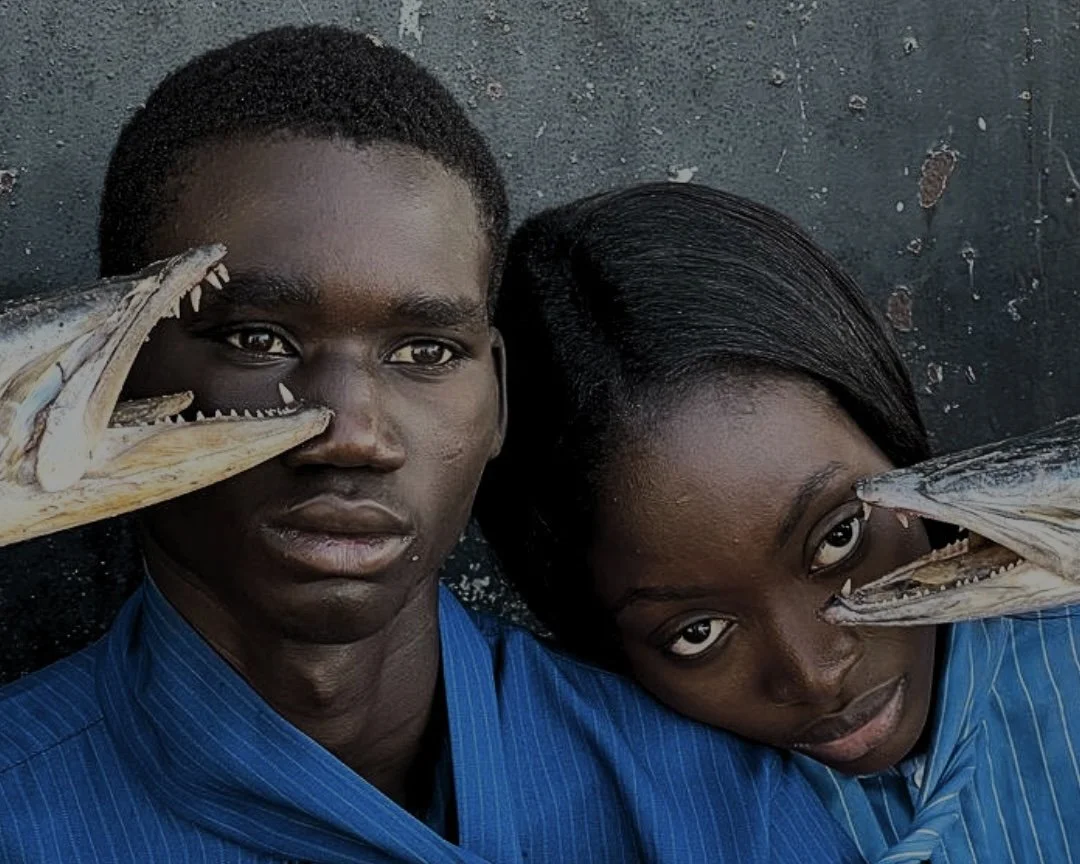
Backstage of editorial directed by Penda Seck
Epigraph
“Our terribleness is our survival as beautiful beings, any where. Who can dig that? Any where, even flying through space like…” - Amiri Baraka, In Our Terribleness
“Somebody / anybody / sing a black girl's song / bring her out / to know herself / to know you / but sing her rhythms / carin/ struggle/ hard times / sing her song of life” - Ntozake Shange, For Colored Girls Who Have Considered Suicide / When the Rainbow is Enuf
It is hard to recall a time when Black people weren't told by dominant society to be quiet about our pain. For centuries, Black writers have depicted the struggle of swimming against the current of a white society which seeks to silence Black expression. Under a Western lens, Black emotion is deemed too loud, too visceral, too challenging. Contemporarily, the rise of AI and progressing dissolution of physical media sees that Black storytellers face staggering levels of censorship and reduced visibility.
Despite this, Black interiority in all its delight, suffering, ecstasy, and exasperation demands uninhibited expression. This is the "doing language” that Toni Morrison evoked when she said, “There is no time for despair…no need for silence, no room for fear. We speak, we write, we do language. That is how civilizations heal."
Thus, 21st century Black storytellers stand at an opening of possibilities. Convened here, we are faced with obstacles both old and new, threats both familiar and foreign.
It is from this place that we must look toward the Afrosurrealist.
+
The school of literary and artistic work named Afrosurrealism sprung into being in 1974 when Amiri Baraka began using the term, “Afrosurreal Expressionism” to describe Henry Dumas’ writing. Baraka lauded Dumas’ skill at “creating an entirely different world organically connected to this one…the Black aesthetic in its actual contemporary and lived life.”
Over thirty years later, after receiving permission from Baraka to expand the term, D. Scot Miller offered, “The Afrosurreal Manifesto.” In making a distinction from Afrofuturism, which is focused on speculating future possibilities of Blackness, Miller writes, “To the Afro-surrealist, the Tasers are here. The Four Horsemen rode through too long ago to recall. What is the future? The future has been around so long it is now the past. Afrosurrealists expose this from a “future-past” called "RIGHT NOW.”
Afrosurrealism employs surreal and dreamlike imagery to comment on contemporary conditions of Black life. Existing as a counter-cultural style of literary expression, it critiques and disrupts dominant colonial narratives by producing a discordance in reality from which sociopolitical critiques emerge. It yields a bizarre, absurd image to expose the contradictions and follies Black people are made to experience in America. Afrosurrealism is concerned with the notion of a hidden world which exists beyond the visible one that seems to constitute our lived experiences. It is this world, comprised of manifold marvels, mysteries, and portals to ancestral memory, that the Afrosurreal writer seeks to uncover.
Scholar and curator, Terri Francis wrote that Afrosurrealism tells the story of how “it emerged somewhat mysteriously from oceans of forgotten memories and discarded keepsakes.”
Afrosurrealism is the right now. It is the dream. The strange. Afrosurrealism seeks to unearth all that which Black people have been made to repress. It is those memories Lucille Clifton told us some people be mad at her sometimes for remembering.
+
This world, dominated by concepts of Western minimalism which seek to contain and restrict voice and expression, designates the Black Maximalist as living disruption of erasure and confinement. Within Afrosurrealist literature, excess functions as a resistance to invisibilization. More specifically, sensory maximalism, in its amplification of Black interiorities and Black emotion, subverts the constraints which tell Black people we must be quiet, emotionless, and always able to endure.
Afrosurreal writers reject detached narratives in favor of impassioned stories and write an excess of layered, at times paradoxical, sensory details to create a wide spectrum of deep emotions within readers.
+
Afrosurealism has been employed in several highly recognizable Black works of literature: Beloved by Toni Morrison, Invisible Man by Ralph Ellison, and Kindred by Octavia Butler.
The Saint Heron Library, a new media center by Solange Knowles, which itself embodies Black Maximalism in its refusal to let the rare, out-of-print work of Black writers and artists slip into oblivion, features several Afrosurrealist texts.
One such text, In Our Terribleness by Amiri Baraka and Fundi, blends poetry, prose, and photography to amplify the intimate experiences of Black life. In Our Terribleness is a reverie of sound and movement in which Black emotion is expressed as a collective sensorium primarily through sonic and kinesthetic immersion.
“Terribleness” here refers to the Black linguistic tradition of subversion where what is terrible becomes what is good. Baraka writes, “to be bad is one level but to be terrible, is to be badder dan nat.” In continuing this strategy of subversion, we must consider what it would mean to reject shrinking to Western limitations and embrace being even more than “too much.”
Sensory maximalism in In Our Terribleness, manifests in the amplification of everyday life experiences as astonishments, the grand emotions that are felt by the entire community, and the visceral overload of the senses.
Baraka reveals his reverence for Black music through an abundance of auditory details which deeply immerse the reader into his scenes. With phrases like, “Drums hammer the streets of America,” “the music of the blade,” and “O beautiful sounds of the existent,” Baraka applies constant phonic sensations to signify both the precarity and the enchantment of Blackness in America. In doing so, he invites the reader into experiencing all the stomps, laughs, shouts, and drumbeats that make up the sounds of Black life.
The addition of Fundi’s photography invites readers into a multisensory experience which captures Black people unposed, going about their everyday lives. These photos offer an image of Blackness that is unconcerned with the white gaze. They reveal the possibilities of the other world that Afrosurrealists fixate upon; an unmediated landscape in which the Black body can exist freely as a “beautiful thing,” like Baraka would say. Within these pages, Black gestures are not merely positions to situate the body; a hand on the hip or a stride across the street isn’t mundane. Rather, all the positions one finds oneself in throughout the day act as a “continuous exercise in astounding grace.”
With each section, the novel deepens its on-page sensorium to amplify Black emotion as something that is experienced not in solitude, but by the entire collective. This choice signifies that if we are not alone in experiencing our emotions, then we are not alone in the fight against erasure.
Black interiority is laid bare in In Our Terribleness through its assertion that in a society determined to extinguish Black expression, even Black mundanity is worthy of being center stage. It is through this divergence from status-quo that “terribleness” arrives and is asserted by Baraka as integral to Black survival.
In our terribleness, we take after the Black Maximalist indulging freely in a literary abundance of the senses which boldly affirms that Black emotion is just enough. Unearthed from this abundance, Black histories and defiant political assertions, previously forcibly repressed, are made legible once more. In our terribleness, Black emotion bursts from constraints, roams unbridled in the streets, and breaks open other worlds in which Black people have unconditional freedom to express outwardly all which is felt inside.
“Our terribleness is our survival as beautiful beings, any where. Who can dig that? Any where, even flying through space like we all doing, even faced with the iceman, the abominable snowman, the beast for whom there is no answer, but change in fire light and heat for the world.” - Amiri Baraka, In Our Terribleness
+